
What is this document?
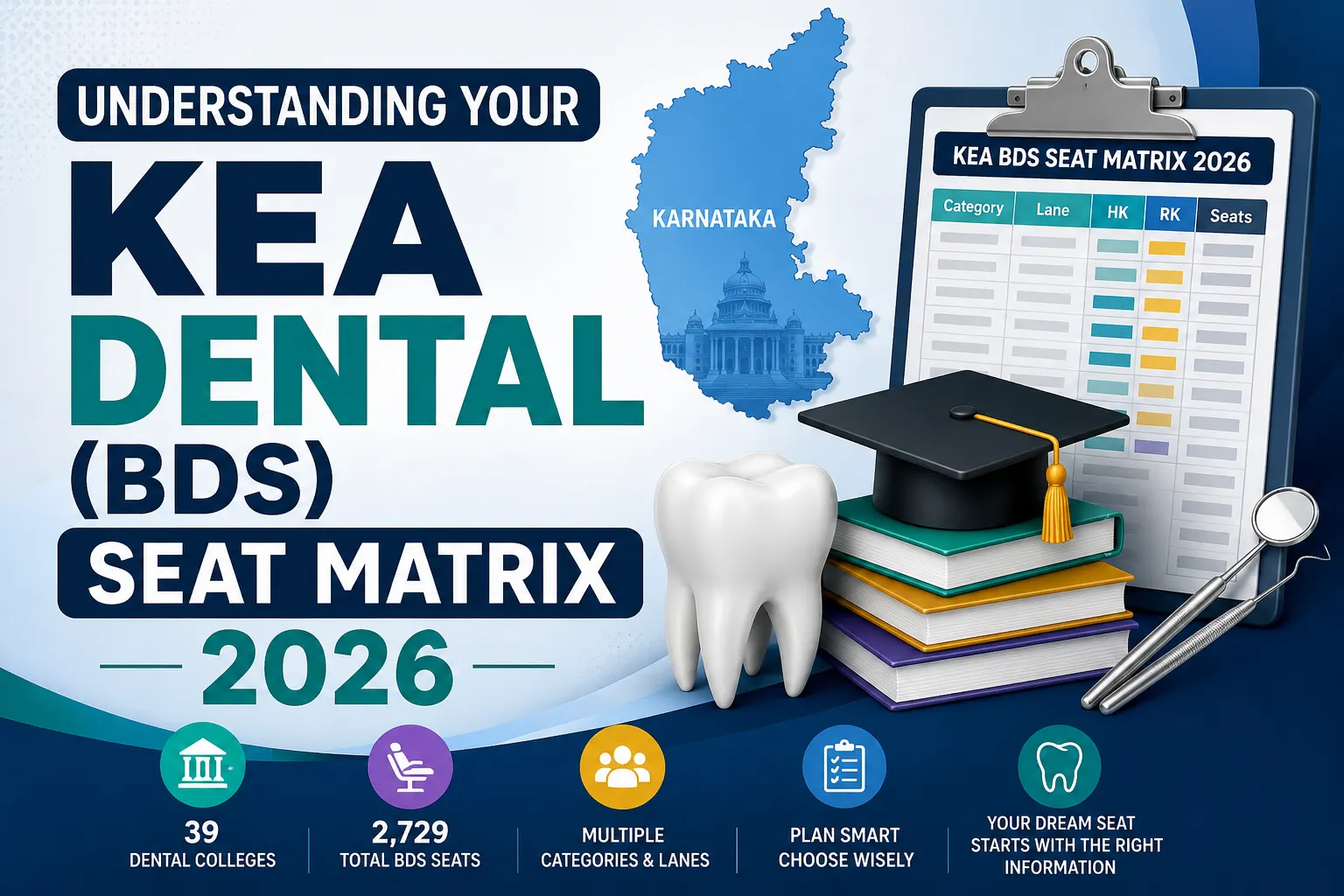
This is the official list of every dental (BDS) college seat available in Karnataka this year, and who is allowed to compete for each seat.
Think of it like a giant seating chart for a train. Before you can book your seat, you need to know:
- Which train (college) is running
- How many seats it has
- Which seats are “general” and which are reserved for specific passengers (students)
The KEA seat matrix does exactly this — for dental college admissions.
The Big Picture — Karnataka Dental Seats 2026
| Details | Information |
|---|---|
| 🏥 Total Dental Colleges | 39 |
| 🪑 Total BDS Seats | 2,729 |
| 📋 Course | BDS (Bachelor of Dental Surgery) |
| 📅 Matrix Released | 7 August 2026 (Provisional — numbers can change slightly before final rounds) |
“Provisional” means: This is a draft list. A few seats may be added, removed, or corrected before the final counselling rounds. Always check the KEA website for the latest version before submitting your options.
What Kinds of Colleges Are on This List?
Not all 39 colleges are the same. Here’s how they break down:
| College Type | What It Means | Number of Colleges |
|---|---|---|
| 🏛️ Government | Run and funded by the Karnataka government. Lowest fees, most competitive. | 3 |
| 🏢 Private Unaided | Privately owned, no government funding. Fees are higher. | 20 |
| 🕌 Minority (L/R) | Run by a religious or linguistic minority community (e.g., a specific community trust). A portion of seats is reserved for students of that community. | 13 |
| 🎓 Deemed / Private University | Affiliated to a private university rather than a government body. Often has its own separate admission process for some seats. | 3 |
Simple takeaway: Government colleges are cheapest but hardest to get into. Private and Deemed colleges are easier to get into but cost significantly more.
The Three “Lanes” Every Seat Belongs To
Every college’s seats are split into three separate competition lanes. A student can usually only compete in the lane they are eligible for:
| Lane | Who Competes Here |
|---|---|
| General | Any student who studied in a regular (non-Kannada) medium school |
| Rural | Students who studied for 7+ years in a school located in a rural area of Karnataka |
| Kannada Medium | Students who studied in a Kannada-medium school |
Example: If you studied in an English-medium school in a Karnataka city, you compete only in the General lane. If you studied in a Kannada-medium village school for most of your schooling, you may be eligible for the Rural and/or Kannada Medium lane too — which usually means less competition for you.
Reservation Categories — Explained in Plain English
Inside each lane, seats are further divided by reservation category. This is the part that confuses most families, so here it is in simple terms:
| Code | Full Meaning | Who It’s For |
|---|---|---|
| GM | General Merit | Open to all students, regardless of caste category — the “unreserved” seats |
| SCC / SCA / SCB | Scheduled Caste (sub-groups) | Reserved for students belonging to Scheduled Caste communities |
| ST | Scheduled Tribe | Reserved for students belonging to Scheduled Tribe communities |
| Category-1 (C-1) | Most Backward Class | Reserved for the most backward community group as classified by the Karnataka government |
| 2A | Backward Class – Category IIA | Reserved for specific backward communities listed under Category 2A |
| 2B | Backward Class – Category IIB | Reserved for specific backward communities listed under Category 2B |
| 3A | Backward Class – Category IIIA | Reserved for specific backward communities listed under Category 3A |
| 3B | Backward Class – Category IIIB | Reserved for specific backward communities listed under Category 3B |
Important: These are official Karnataka government categories. A student’s actual category depends on their caste certificate, not on personal choice. If you’re unsure which category you belong to, check your caste/community certificate — this determines which reserved seats you can apply for, in addition to GM seats.
Golden Rule: Every reserved-category student can also compete for GM seats. GM is the one category open to everyone.
HK vs RK — The Regional Quota
You’ll notice every college’s seats are also split into two rows: HK and RK.
| Code | Meaning |
|---|---|
| HK | Kalyana-Karnataka Region Quota (previously called Hyderabad-Karnataka). A constitutionally protected quota under Article 371J, reserved for students from this specific, historically underdeveloped region of North Karnataka (districts like Kalaburagi, Bidar, Raichur, Yadgir, Koppal, Bellary, Vijayanagara). |
| RK | Rest of Karnataka. The regular quota for everyone else in the state. |
Simple takeaway: If your permanent residence/schooling is in the Kalyana-Karnataka districts, you get an additional set of seats to compete for under HK — on top of the normal RK seats.
Special Quota Seats — Explained
Beyond the caste-based and regional categories, colleges also set aside a small number of seats for specific, special circumstances:
| Code | Meaning |
|---|---|
| OPN | Open quota (management-level open seats, typically in private/deemed colleges) |
| GMPH / GMP | General Merit — Private/Payment quota seats in private colleges |
| OTH Q | Other Quota (institution-specific quota) |
| NRI | Non-Resident Indian quota — for children of NRIs, usually at a higher fee |
| MMH, MEH, MC, MM, MK, MU, MA, ME | Minority community quota codes — seats reserved for students belonging to the specific religious or linguistic community that runs that particular minority college (these codes vary by college and community) |
| JK | Quota for students from Jammu & Kashmir |
| NCC | National Cadet Corps quota |
| SPO / S-G | Sports quota (S-G = Sports – Girls) |
| Defence / Ex-Defence | Reserved for children of serving or ex-servicemen |
| Anglo Indian | Reserved for the Anglo-Indian community |
| CAPF / Ex-CAPF | Central Armed Police Forces (serving/ex-personnel quota) |
| PH | Persons with Disability (Physically Handicapped) quota |
Simple takeaway: Unless you specifically fall into one of these special groups (NRI, sports, defence family, PwD, etc.), you don’t need to focus on this section. Most students will only ever look at GM + their caste category + their regional/medium lane.
Government vs Private vs Minority — Seat Counts to Know
Here’s a quick summary students actually use during counselling:
- 🏛️ Government colleges (3 colleges) — Very low fees, extremely high competition. Mostly filled by top-rank GM and reserved-category students.
- 🏢 Private Unaided colleges (20 colleges) — Larger number of seats overall, higher fees, comparatively easier to get admission.
- 🕌 Minority colleges (13 colleges) — A portion of seats reserved for the minority community; remaining seats open through regular counselling.
- 🎓 Deemed/Private University colleges (3 colleges) — Some seats through KEA, but these institutions may also run a separate management-quota process — always double-check directly with the college.
How Should a Student Actually Use This Document?
Here’s the step-by-step approach during KEA counselling:
- Identify your category — GM, or your specific reserved category (from your caste certificate).
- Identify your lane — General, Rural, or Kannada Medium (based on your schooling).
- Check if you qualify for HK — only if you’re from the Kalyana-Karnataka districts.
- Check special quotas — only if applicable (NRI, sports, defence, PwD, etc.).
- Shortlist colleges by type (Government first if your rank supports it, then Private/Minority as backup options) based on your budget and rank.
- Cross-check available seats in your specific category + lane combination for each shortlisted college before filling your option entry — a college may show 100 total seats, but only 1–2 may be available in your specific category.
Example: A student with a 2A category certificate, studying in a Kannada-medium rural school in Kalyana-Karnataka, could potentially compete under five different pools at the same college: GM, 2A, Rural, Kannada Medium, and HK. This significantly increases their chances compared to a student who only qualifies for GM.
Key Takeaways ✅
Before you fill your KEA options, remember:
- ✅ There are 39 dental colleges and 2,729 total BDS seats in Karnataka this year.
- ✅ College types matter: Government = cheap but hardest, Private/Minority/Deemed = costlier but more accessible.
- ✅ GM is open to everyone. Reserved categories (SC, ST, 1, 2A, 2B, 3A, 3B) are based on your caste certificate — and you can always also compete under GM.
- ✅ You compete in one schooling lane: General, Rural, or Kannada Medium — based on where you studied, not where you live.
- ✅ HK is an extra advantage only for students from the Kalyana-Karnataka region.
- ✅ Special quotas (NRI, sports, defence, PwD, minority) only apply if you specifically belong to that group.
- ✅ A college’s “total seats” number is misleading on its own — always check how many seats exist in your exact category + lane before ranking that college in your option list.
- ✅ This matrix is provisional — always verify the latest version on the official KEA portal before submitting your final option entry.
This guide is based on the KEA Dental (BDS) Provisional Seat Matrix 2026 (released 07/08/2026). For official and updated figures, always refer to the KEA website directly.

0 Comments